
Morii Dero
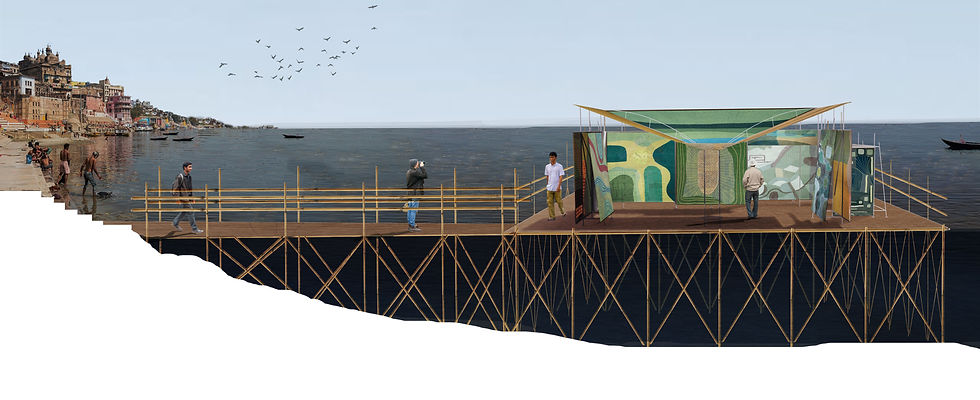
When Morii began imagining the Dero as a tent to be entered and inhabited through their textiles, our role was to translate that intention into a structure capable of holding both stillness and the display of their work. Conceived beyond an enclosure, the tent becomes a calibrated environment, one that slows the body, draws attention inward, and allows the textiles to be encountered and experienced.
The textiles bring together embroidery practices from Kutch, Bengal, and Bihar, including Jat cross stitch, each carrying its own rhythm and way of making. The space unfolds through these variations, allowing the work to be encountered in layers.
When Morii began imagining the Dero as a tent to be entered and inhabited through their textiles, our role was to translate that intention into a structure capable of holding both stillness and the display of their work. Conceived beyond an enclosure, the tent becomes a calibrated environment, one that slows the body, draws attention inward, and allows the textiles to be encountered and experienced.
The textiles bring together embroidery practices from Kutch, Bengal, and Bihar, including Jat cross stitch, each carrying its own rhythm and way of making. The space unfolds through these variations, allowing the work to be encountered in layers.


Assembly was central to the design process. The structure needed to be precise, legible, and reversible, imagined as a mobile system that could travel, adapt, and be reassembled across contexts. Composed of 25 mm hollow metal rods, the framework is developed as a kit of parts, allowing for ease of transport, repeatability, and clarity in assembly. Whether placed in an open landscape or within a built interior, it is intended to function both as a place of gathering and as a space for display.


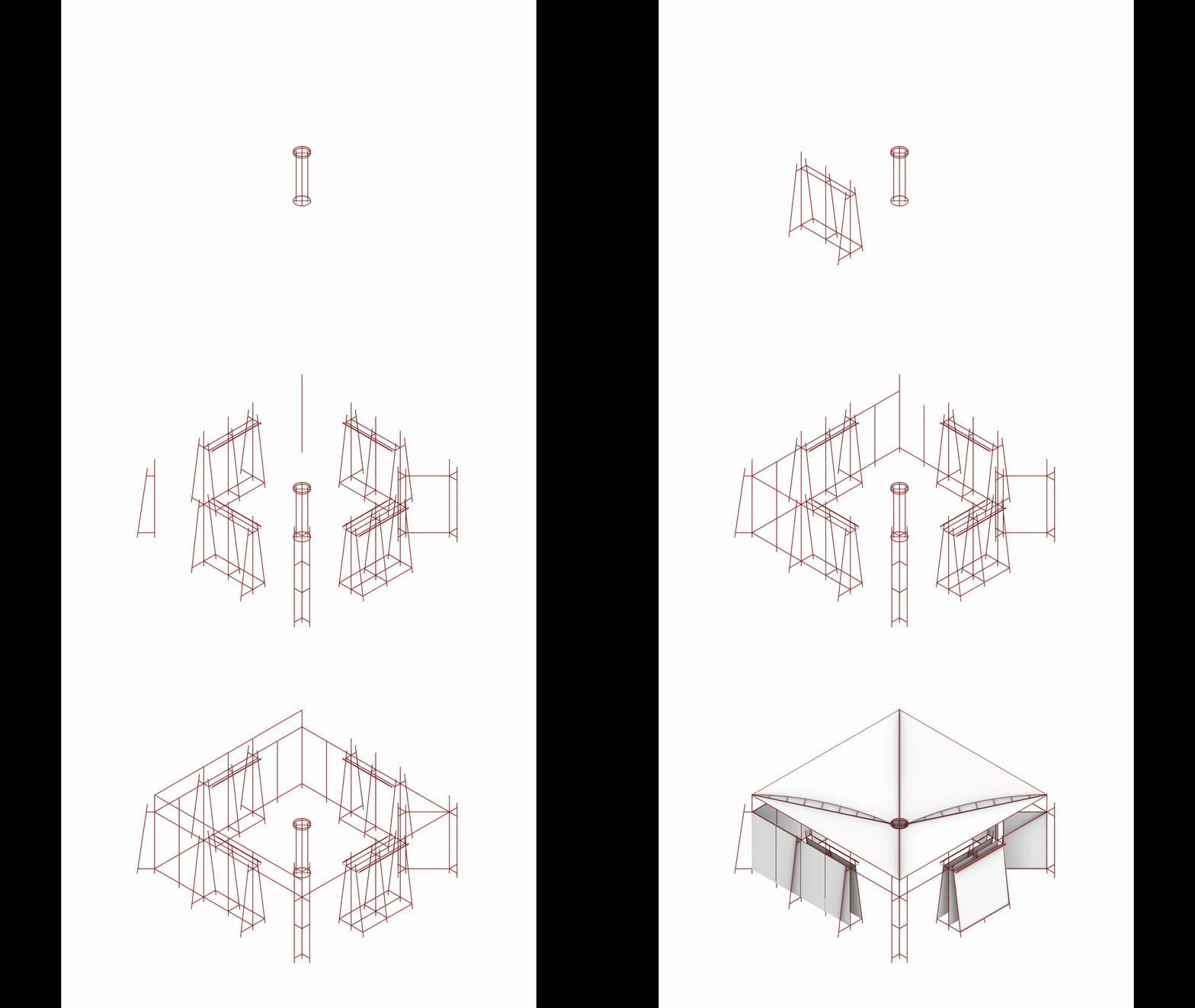
The roof slopes gently towards the centre, lowering the volume and anchoring the body in a sense of calm. As it moves outward, it lifts at the pods, staging the textiles and allowing them to be read as an exhibition. A diagonal framework on the exterior lightly intersects the textile skin, making the act of framing visible and lending the structure a scaffolded lightness, evoking the assembled and transient nature of a tent.




This balance between introspection and encounter, between enclosure and openness, shaped every decision. Morii Dero is conceived as a system that can continue to move, assemble, and find new ground across different places.
A travelling pavilion shaped by textile, memory and presence - Mobile Structure 2025
Location:
Everywhere
Designed and assembled for Godrej Conscious Collective
Design Team:
Atharva, Naomy, Samyak
Execution Assistance:
Ann, Nirjar, Hirva
Guidance:
BL Manjunath
Fabricator:
Chetan Dave
Textiles:
Morii Design — Brinda Dudhat and Kabir, through artisans from Bihar, Bengal, and Bhuj


Morii Dero
When Morii began imagining the Dero as a tent to be entered and inhabited through their textiles, our role was to translate that intention into a structure capable of holding both stillness and the display of their work. Conceived beyond an enclosure, the tent becomes a calibrated environment, one that slows the body, draws attention inward, and allows the textiles to be encountered and experienced.
The textiles bring together embroidery practices from Kutch, Bengal, and Bihar, including Jat cross stitch, each carrying its own rhythm and way of making. The space unfolds through these variations, allowing the work to be encountered in layers.
When Morii began imagining the Dero as a tent to be entered and inhabited through their textiles, our role was to translate that intention into a structure capable of holding both stillness and the display of their work. Conceived beyond an enclosure, the tent becomes a calibrated environment, one that slows the body, draws attention inward, and allows the textiles to be encountered and experienced.
The textiles bring together embroidery practices from Kutch, Bengal, and Bihar, including Jat cross stitch, each carrying its own rhythm and way of making. The space unfolds through these variations, allowing the work to be encountered in layers.
Assembly was central to the design process. The structure needed to be precise, legible, and reversible, imagined as a mobile system that could travel, adapt, and be reassembled across contexts. Composed of 25 mm hollow metal rods, the framework is developed as a kit of parts, allowing for ease of transport, repeatability, and clarity in assembly. Whether placed in an open landscape or within a built interior, it is intended to function both as a place of gathering and as a space for display.
The roof slopes gently towards the centre, lowering the volume and anchoring the body in a sense of calm. As it moves outward, it lifts at the pods, staging the textiles and allowing them to be read as an exhibition. A diagonal framework on the exterior lightly intersects the textile skin, making the act of framing visible and lending the structure a scaffolded lightness, evoking the assembled and transient nature of a tent.
This balance between introspection and encounter, between enclosure and openness, shaped every decision. Morii Dero is conceived as a system that can continue to move, assemble, and find new ground across different places.
A travelling pavilion shaped by textile, memory and presence - Mobile Structure 2025
Location:
Everywhere
Designed and assembled for Godrej Conscious Collective
Design Team:
Atharva, Naomy, Samyak
Execution Assistance:
Ann, Nirjar, Hirva
Guidance:
BL Manjunath
Fabricator:
Chetan Dave
Textiles:
Morii Design — Brinda Dudhat and Kabir, through artisans from Bihar, Bengal, and Bhuj